
A sentence can read perfectly and still make a promise your business cannot keep.
That is the problem I want marketing leaders to think about when they scale content with AI. Producing more pages, campaigns, and language versions is useful only if customers can rely on what those assets say.
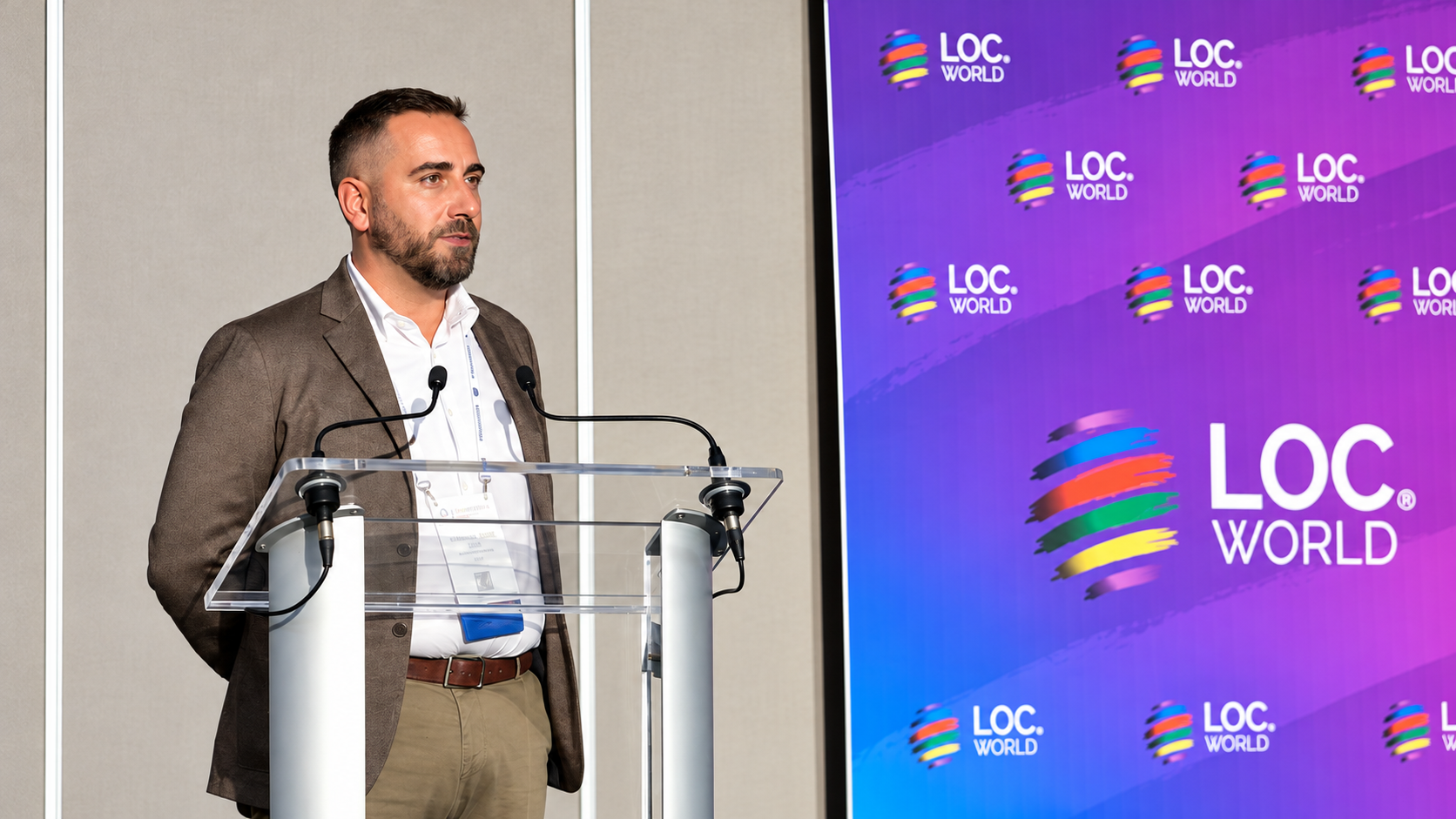
On October 20, I spoke at LocWorld56 Vancouver about translation quality and risk. My microtalk, From Fluency to Risk: Rethinking Translation Quality in the Age of AI, focused on how organizations can direct human review towards the content where errors matter most.
Here, I want to extend that discussion to a broader marketing question: who owns the accuracy of your brand’s promises as content moves through AI tools, teams and markets?
AI content governance is the set of responsibilities, checks, and approval rules a business uses to keep AI-assisted content accurate, supported, and appropriate for its audience. For marketing teams, that means knowing which claims are approved, what needs human review, who can authorize publication, and how corrections reach every affected version.
Why fluent content can still create a business problem
Consider a hypothetical SaaS company expanding into a new market.
Its original pricing page promises email support during business hours. An AI-assisted rewrite turns that into “support whenever you need it.” A translated landing page goes further and says support is available around the clock.
Every version sounds reasonable in isolation. Together, they describe different products.
The buyer does not care whether the discrepancy began in a prompt, a translation or an enthusiastic copy edit. They care that the service does not match the promise.
That is why I see content accuracy as part of growth strategy. A misleading promise can create the wrong inquiry, distort a sales conversation, or leave customer success explaining a commitment nobody approved.
Publishing faster is valuable. Publishing contradictions faster creates work somewhere else.
What LocWorld Vancouver has to do with marketing leadership
My role as CMO of LanguageCheck.ai puts me close to the challenges of evaluating multilingual content. It also gives me a specific commercial interest in translation quality, which is worth making explicit.
Translation is a useful place to examine this problem because there is an original meaning to preserve. A reviewer can ask whether the translated content changes a condition, omits a limitation, or makes a statement more certain.
Marketing teams should ask those questions throughout the content life-cycle.
Does the sales deck preserve the limits of the case study? Does the campaign headline accurately describe the product? Does the local landing page offer something the business can actually deliver in that market?
Before Vancouver, I wrote about how conferences contribute to B2B trust. This follow-up takes the subject of my talk into the operating decisions behind that trust.
A brand needs a process for keeping its promises consistent after the first piece of content is approved.
How should marketing teams prioritize AI content review?
Prioritize review by the consequence of an error, the audience’s exposure to it, and the uncertainty surrounding the content. A draft for internal brainstorming needs a different approval process from a published pricing page.
Here is a starting point I would adapt to each business:
| Content situation | What could go wrong? | Suggested review approach |
|---|---|---|
| Internal ideas and early drafts | Unverified ideas become accepted facts | Label drafts and verify claims before reuse |
| Educational articles and newsletters | Unsupported claims or outdated explanations reach readers | Editorial review and source checks before publication |
| Product, pricing and comparison pages | Buyers misunderstand capabilities, costs or eligibility | Approval by the relevant product or commercial owner |
| Translated conversion pages | Meaning, conditions or the offer change between markets | Linguistic review plus confirmation of local offer accuracy |
| Safety instructions or regulated claims | Errors cause serious harm or compliance exposure | Specialist review under the applicable requirements |
These are planning categories, not a universal approval policy. A seemingly routine article may contain a high-risk claim. A short sentence can deserve more scrutiny than a long document.
Automated checks can help flag potential issues. Their output also needs evaluation: an unflagged passage is not proof that the passage is correct.
A practical AI content governance workflow
1. Establish the approved facts
Start with the information people repeatedly reuse: product capabilities, pricing conditions, availability, approved claims, evidence and limitations.
Give each important fact an owner and a review date. Link it to the underlying documentation.
The aim is to make verification straightforward. A writer should not need to search through old presentations to discover whether an integration is available or merely planned.
2. Preserve the conditions attached to a claim
A result often depends on context.
“Reduced processing time in a six-week pilot involving one team” cannot safely become “cuts processing time across your business.”
Keep the timeframe, scope, and relevant conditions close to the claim. When generating summaries, headlines or translations, explicitly check whether those conditions survived.
This is also where brand voice needs discipline. More confident wording should not quietly become a stronger factual promise.
3. Assign approval to someone who can verify the substance
An editor can improve clarity without knowing whether a technical statement is true.
Separate language review from factual approval when the content requires both. A product owner might verify capability; a qualified language professional might verify meaning in another language; marketing might check positioning and audience fit.
Make the handoff explicit. “The team reviewed it” is difficult to investigate when something goes wrong.
4. Track where approved claims are reused
A correction is incomplete if it reaches the homepage but leaves the same claim in a downloadable guide, a translated campaign and a sales deck.
For important claims, maintain a simple record of the source, owner, and dependent assets. Start with commercially sensitive pages rather than attempting to catalog everything at once.
The useful question is: if this fact changes tomorrow, can we identify what needs updating?
5. Measure quality alongside production speed
Track how long review takes, how often content returns for factual correction and which errors reach publication.
Separate stylistic preferences from material mistakes. Ten edits to tone do not necessarily matter more than one incorrect eligibility condition.
Where possible, connect the findings to commercial feedback: confused inquiries, recurring sales objections and customer complaints. That helps leadership decide which checks earn their place in the workflow.
How does content governance support SEO, GEO and AEO?
SEO, generative engine optimization and answer engine optimization all benefit from content that clearly answers relevant questions. Governance helps ensure those answers remain accurate when they are updated, summarized, or translated.
In my article on B2B visibility when buyers ask AI first, I explored how brands appear during AI-assisted research. The operational question here is what those systems will find when different pages describe your offer differently.
You cannot control every external summary. You can improve the material you publish: clear definitions, supported claims, current information, and useful internal links.
Google’s guidance on generative AI search reinforces the importance of established SEO practices and distinctive, useful content. It does not prescribe a special schema that guarantees AI visibility.
Content governance is not a ranking shortcut. Its value is giving readers—and systems retrieving your pages—information that is easier to verify and less likely to contradict itself.
If you want to examine discovery more broadly, use my practical B2B AI visibility audit alongside this review of content accuracy.
Where should a founder or CMO start?
Choose one journey with a clear commercial purpose: a campaign, a product launch or an expansion into another language.
Read the ad, landing page, product description, follow-up email and sales material together. Check whether they make the same promise.
Then ask:
- Which claims could materially affect a buying decision?
- Where is the evidence behind each claim?
- Who approves factual changes?
- Which versions need updating when a fact changes?
- How will we know whether an error escaped review?
You may discover that the immediate constraint is an unclear owner, an outdated source document or a missing approval step. Fix that before increasing production.
The question I would bring into the next planning meeting is simple:
If AI helped us publish twice as much next month, could we still stand behind every important promise?
I work with founders and B2B leadership teams as a fractional CMO and growth visibility advisor, connecting positioning, content, search, AI visibility, and commercial priorities.
If your content operation is growing faster than your ability to keep it coherent, tell me where the friction is. We can discuss what needs to change.