

Most founders treat the launch video as a launch-day asset. It gets posted, it trends for a day or two, and then it disappears into the feed archive.
That is a costly misreading of what a launch video is. In the work I do with VC-backed founders, the launch video is the single most reusable piece of storytelling a startup will produce in its first year. Used properly, it keeps working for months: in search, in AI answers, in sales calls, in investor updates.
This piece extends my Growth Visibility Framework to product launches. It introduces the idea I call the storytelling flywheel: the mechanism that turns one launch story into compounding visibility.
Why Most Launches Decay in a Week
A launch is built for a spike. Everything is aimed at one window: the post, the creator push, the Product Hunt day, the founder in the replies for the first hour.
That window matters. But a spike is not visibility. Visibility is what is still findable, citable and referable after the spike has passed.
I see the same pattern again and again. A startup spends weeks and a real budget on a launch film. It pulls impressive numbers on day one. Three months later, a buyer asks ChatGPT or Perplexity for tools in that category, and the brand does not appear in the answer.
The video did its job. The system around it did not exist. This is the same gap I described in Why Most Marketing Efforts Don’t Fail — They’re Just Invisible: the problem is rarely failure. It is invisibility.
The Storytelling Flywheel
The storytelling flywheel is the loop that turns a single launch story into visibility that compounds. Each turn makes the next one cheaper and faster.
It has five stages:
- A sharp story. One buyer, one pain, one outcome. If you cannot say it in a sentence, the video will not save it.
- One core asset. The launch video is the most compressed version of that story, in a form people actually watch and share.
- Distribution. The asset is cut down and placed everywhere your buyers, investors and peers pay attention: the website, executive social, partner content, podcasts, sales decks.
- References. Third parties embed it, write about it and link to it. Those mentions become the evidence that search engines and AI systems draw on.
- Authority. Accumulated references make the brand citable. The next launch story starts from a position of recognition instead of from zero.
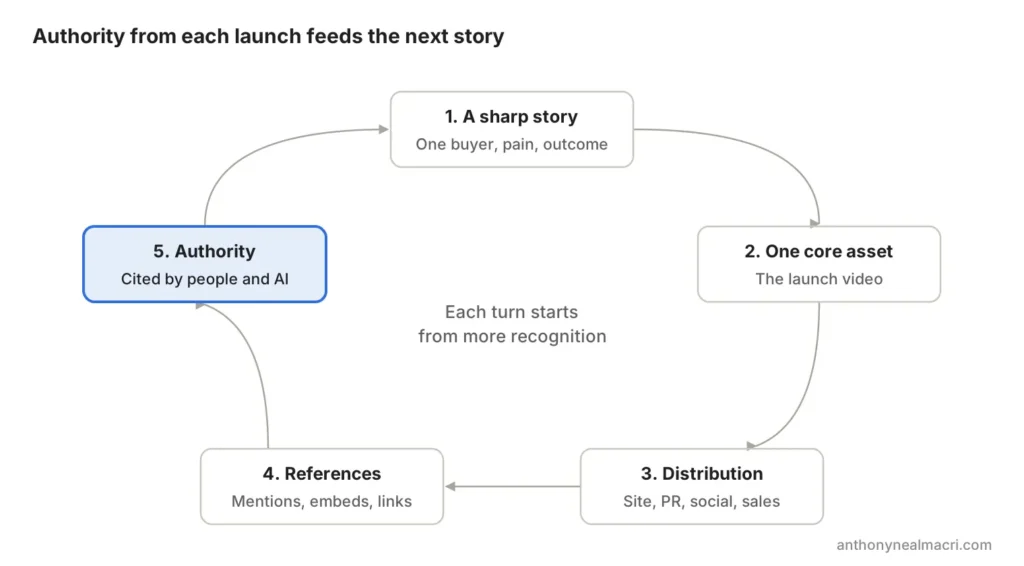
The loop is what separates a launch that spikes from a launch that compounds. Without stages three to five, the video is a one-week asset. With them, it becomes infrastructure.
Where the Launch Video Sits in the Growth Visibility Framework
The launch video belongs in all three layers of the framework. Most founders only use it in the third.
| Layer | What the launch video does | What most founders miss |
|---|---|---|
| 1. Authority Foundation | States the point of view and puts the founder’s face and voice on it | Building the video around features instead of a position on how the market works |
| 2. Visibility Distribution | Becomes the anchor for SEO, GEO, AEO, PR and executive social | Posting it once on launch day, never embedding it, transcribing it or pitching it |
| 3. Acquisition Alignment | Warms paid audiences, sales outreach and investor conversations | Running ads before the story has earned any recognition |
Layer 1. A launch video is a public statement of what you believe about your market. Founder-led or hybrid cuts are especially strong here, because they attach a real person to the position. That is exactly the entity signal AI systems look for.
Layer 2. This is where the flywheel turns. Host the video on your own site with a full transcript and structured data, so search engines and LLMs can parse it. Pitch it alongside the founder’s story. Give partners and press an embeddable version. I covered the mechanics of each channel in SEO, GEO and AEO: The Three Disciplines Shaping Search in 2026.
Layer 3. Once the story has been seen and referenced, paid and outbound channels run into a warmer audience. The same cut that trended on launch day becomes the opening asset in a sales sequence. As I argued in Paid vs. Organic User Acquisition, acquisition spend works harder when it runs on top of authority.
What Good Launch Storytelling Looks Like
The flywheel only turns if the story at its centre is strong. A forgettable video will not earn references, however well you distribute it.
One studio whose thinking lines up closely with this is Flowjam, a London-based team that makes story-driven launch videos for AI startups. Its founder, Adam Petty, started it after making the launch video for his own SaaS product, Zaap.ai, when he could not find one he liked. Other founders kept asking who made it.
Flowjam’s thesis is one I agree with: launch content should feel like a movie trailer, not a corporate explainer. You can build brilliant software, but if the story does not land, nobody cares.
The studio has worked with dozens of Y Combinator companies. According to Flowjam, HeyGen’s launch video passed 7 million views in 48 hours, and Bloom’s passed 1.5 million in 24. Outset, which raised a $17M Series A in June 2025, is also in its portfolio.
What I find most useful in Flowjam’s approach is the script structure: open on the buyer’s pain, name the buyer, show the product solving it, then cut to the outcome. That is the same discipline Layer 1 asks for. A clear point of view, stated in the buyer’s language, is what makes a brand quotable, by people and by AI systems.
Whoever you work with, judge a launch video partner by one question: will this story still be worth referencing six months from now?
How to Turn Your Next Launch Into a Flywheel
Before you brief a launch video, run through four questions.
- Story test. Can you state the buyer, the pain and the outcome in one sentence? If not, fix the positioning before you fix the video.
- Asset test. Will the video live on your own site, with a transcript and structured data, and not only on X and LinkedIn?
- Distribution test. Have you planned at least five places it will appear after launch week: partner content, podcasts, press pitches, sales sequences, investor updates?
- Reference test. In 90 days, if a buyer asks ChatGPT or Perplexity about your category, will anything about this launch be part of the answer?
If the answer to the fourth question is no, the launch is a campaign, not infrastructure. In my experience, the gap almost always sits in the distribution test, not in the video itself.
Frequently Asked Questions
What is a storytelling flywheel?
A storytelling flywheel is a loop in which one sharp brand story becomes a core asset, the asset is distributed widely, distribution earns third-party references, and those references build the authority that makes the next story easier to land. The term comes from my Growth Visibility Framework for VC-backed founders.
How does a launch video help with AI search visibility?
On its own, it doesn’t help much. A launch video helps with GEO and AEO when it is hosted on your own site with a transcript and structured data, and when third parties reference it. AI systems cite what is written about you, not what was trending on launch day.
Should a launch video be animated or founder-led?
It depends on what the buyer needs to trust. Animated cuts suit abstract products like AI infrastructure. Founder-led or hybrid cuts suit categories where buyers need to know who is behind the product, and they add a stronger entity signal.
How long does a launch video keep working?
Without a distribution plan, roughly a week. Inside a storytelling flywheel, it keeps earning references for as long as you keep placing it in new contexts: sales, PR, partner content and your own site.
Final Thought
A great launch video is a story compressed into 60 seconds. The mistake is letting it live for only a week.
The founders who win in 2026 treat the launch as the first turn of a flywheel, not the finish line. The video earns attention. The system around it turns that attention into authority.
If you are a VC-backed founder planning a launch and want the visibility to outlast launch week, get in touch. We can map your launch against the Growth Visibility Framework before a single frame is shot.