
There is a version of marketing where you publish content, optimize a few keywords, and wait for Google to send you traffic. That version still works, partially, probably, for a little while longer.
But it is not the whole game anymore.
Search has fractured. The way people discover brands, get answers, and decide who to trust has changed structurally. And if your visibility strategy was built for 2019, you are already operating at a disadvantage in 2026.
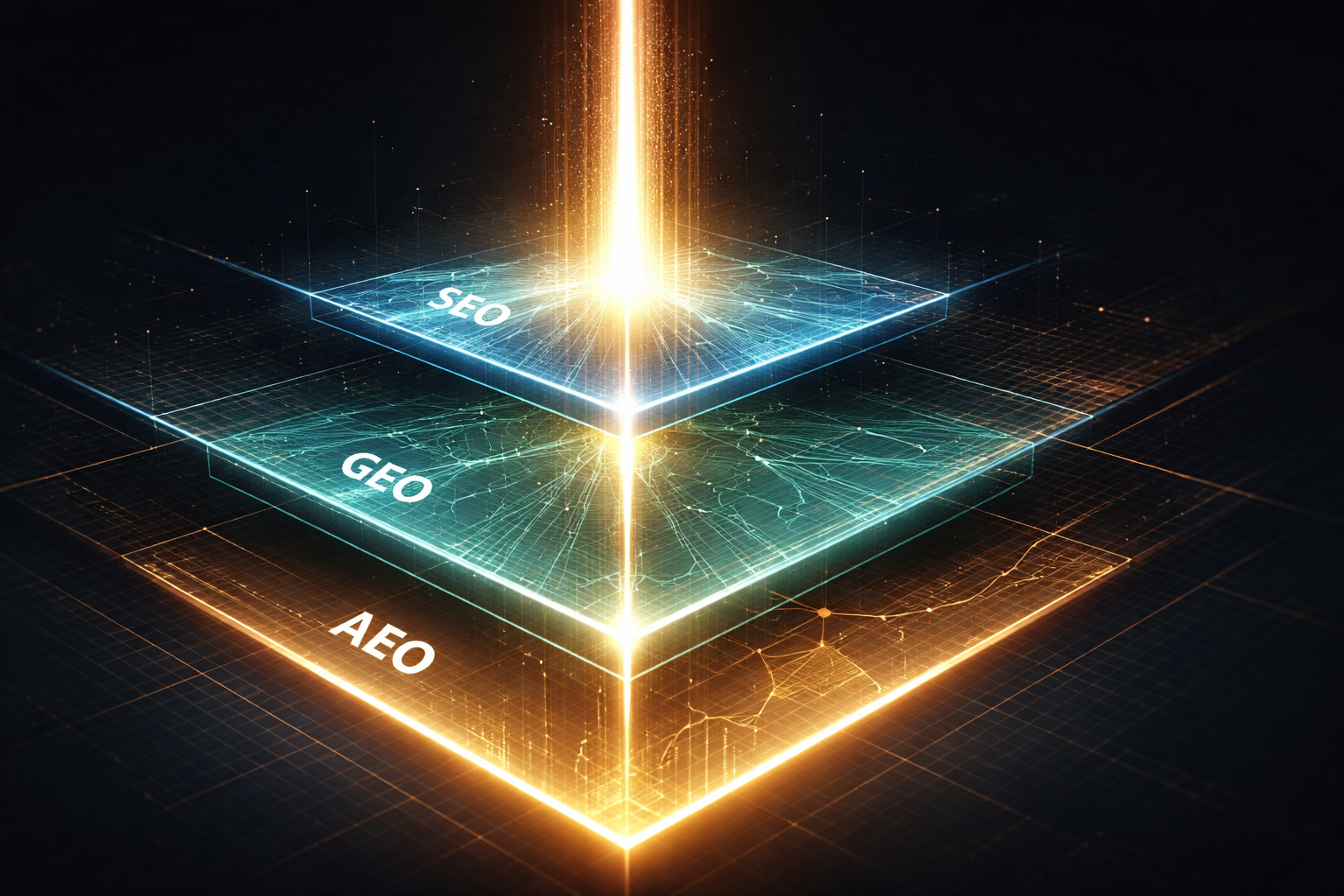
The three disciplines you need to understand, and integrate, are SEO (Search Engine Optimization), GEO (Generative Engine Optimization), and AEO (Answer Engine Optimization). Each one addresses a different layer of how discovery works today. Together, they form the foundation of any serious digital visibility strategy.
Let me break down what each one actually means, how they interact, and why the brands that get this right now will be extremely difficult to displace later.
SEO: The Foundation That Never Went Away
Search Engine Optimization is the oldest of the three. It is also the most misunderstood, not because it is complicated, but because people have been calling it dead for fifteen years, and it keeps surviving.
SEO is the practice of structuring your content, site architecture, and off-page authority signals so that search engines surface your pages for relevant queries. At its core: the right content, in the right format, backed by credible signals, visible to crawlers.
What has changed is not whether SEO matters. It is what SEO rewards.
The keyword-volume era: publish more, target more variations, build more links, is giving way to something more strategic. Search engines have gotten better at evaluating context, intent, and expertise. Google’s E-E-A-T framework (Experience, Expertise, Authoritativeness, Trustworthiness) has made it clear: the algorithm increasingly rewards demonstrated credibility, not just keyword density.
I wrote about this shift directly in Zero-Click Search Isn’t Killing SEO — It’s Exposing Weak Strategy. The brands panicking about zero-click were the same ones whose SEO was built on traffic rather than authority. The brands that are thriving have invested in being genuinely credible sources.
SEO in 2026 is about becoming a trusted entity, not just a ranked URL. That distinction matters more than most people realize.
GEO: Optimizing for the New Interface Layer
Generative Engine Optimization is newer, less understood, and arguably the most consequential shift in search since mobile.
GEO refers to the practice of structuring your brand, content, and digital footprint so that generative AI systems: ChatGPT, Perplexity, Google’s AI Overviews, Claude, and others, surface you accurately and favorably when users ask questions in your space.
Here is the core mechanic: generative AI systems do not crawl and rank the way traditional search engines do. They synthesize. They pull from patterns learned during training, from indexed content, from cited sources, and increasingly from live web retrieval. When someone asks an AI assistant which marketing consultant to work with, or what platform solves a specific problem, the AI constructs an answer: that answer either includes your brand or it does not.
Getting included is not about gaming prompts. It is about being a credible, consistently referenced presence across the digital ecosystem that these systems draw from.
What GEO requires in practice:
- Consistent brand mentions across trusted, authoritative sources. If your name and your positioning appear repeatedly across credible publications, interview features, and industry media, AI systems are more likely to recognize and surface you as a relevant entity.
- Clear, structured content that answers real questions. Generative systems reward clarity. Content that is written in a question-and-answer format, uses natural language, and defines concepts explicitly is easier for AI to synthesize and cite.
- Third-party validation. A single well-crafted blog post does not build GEO authority. Consistent external coverage does. This is why PR has become a core component of modern search strategy, not as a branding exercise, but as infrastructure.
I have been applying this framework directly. My Media-First Growth Framework, covered by EIN Presswire in February 2026, was built around exactly this insight: in an AI-mediated internet, brands compete for references, not just rankings.
GEO is not a replacement for SEO. It is a layer on top of it, one that requires the same fundamentals (credibility, clarity, relevance) but extends them into a different retrieval context.
AEO: Being the Answer, Not Just a Result
Answer Engine Optimization is often conflated with GEO, but they are distinct.
AEO focuses specifically on positioning your content to be surfaced in zero-click contexts: featured snippets, voice search results, AI-generated summaries, and direct answer boxes. The user asks a question; the engine delivers an answer without a click. The brand that is the answer wins, even if the user never visits their site.
This matters for two reasons.
First, zero-click behavior is growing. People increasingly get what they need from search results pages and AI interfaces without visiting a source. That is not necessarily bad, but if your content is not structured to be the source of those answers, someone else’s is.
Second, being the answer builds brand recognition in a uniquely powerful way. When a voice assistant says your name, when a featured snippet shows your explanation, when an AI summary cites your framework, you are embedded in the user’s decision-making process before they have even consciously started evaluating options.
I covered the structural dynamics of this in 0-Click Search Is Here — And It’s Redefining SEO (For the Better) and followed it up with Zero-Click Search Isn’t Killing SEO — It’s Exposing Weak Strategy. The brands that panicked were the ones without real authority. The brands that positioned correctly are getting more visibility, not less.
AEO in practice means:
- Using FAQ-style formatting in content. Explicit questions with clear, concise answers are the preferred format for featured snippets and AI summaries.
- Implementing structured data markup (Schema.org). Schema markup tells engines explicitly what your content is: a FAQ, a how-to guide, a review, so it can be surfaced in rich result formats.
- Answering the actual question first. Before context, before caveats, before the nuance. Lead with the answer. This is counterintuitive for writers but essential for answer engines.
- Matching content to conversational intent. Voice queries and AI prompts are phrased differently from typed search queries. Optimizing for how people ask questions, not just what they search for, is a meaningful tactical shift.
How SEO, GEO, and AEO Work Together
These are not competing priorities. They are a stack.
SEO builds the technical and authority foundation. Without it, nothing else works. Your site needs to be crawlable, fast, and credible. Your content needs to be indexed. Your authority needs to be established through links, mentions, and signals that engines can evaluate.
AEO focuses your content strategy on answering questions directly. It shapes how you write, structure, and mark up your content so that it can be extracted, surfaced, and cited across multiple retrieval contexts, traditional search snippets, voice assistants, and AI summaries alike.
GEO extends your visibility beyond your own site. It is the off-page work: the media placements, the expert citations, the bylined content in industry publications, the consistent presence across trusted platforms that tells AI systems, and the humans who use them, that your brand is a legitimate, frequently referenced authority in its space.
A brand doing all three looks like this:
- They publish well-structured, authoritative content on their own platform (SEO).
- That content is formatted to answer specific questions clearly and concisely (AEO).
- They are also consistently featured in external media, cited in industry publications, and mentioned across credible platforms (GEO).
When an AI system synthesizes an answer about their industry, this brand shows up: because it is everywhere credible sources point.
This is the integrated play. And most brands are still running one layer at a time.
Why This Matters More Than Ever, and Will Only Get More Important
The reason this is urgent is not that AI is going to take over search someday. It already has, in significant ways, and the pace of adoption is accelerating.
Google’s AI Overviews now appear for a substantial portion of queries. Perplexity has grown from a niche tool to a mainstream research assistant. ChatGPT has become a default starting point for millions of users making purchasing decisions, researching vendors, and evaluating experts. Claude, Gemini, and others are being embedded into workflows across industries.
As these systems become more capable and more trusted, the share of discovery that flows through AI interfaces will grow. The brands that are legible to those systems, that appear in their training data, in their cited sources, in their retrieval results, will compound their advantage. The brands that are not will become increasingly invisible, not because they disappeared, but because the interface layer changed and they did not.
I have seen this play out directly with clients. In my work featured on AI in Digital Marketing, I documented how AI-driven content operations are accelerating production while quality assurance and strategic positioning lag behind. The gap between brands that understand the new visibility mechanics and those still playing the old game is widening fast.
And as I noted when Featured.com included me in their Omni-Channel Strategy Expert directory, the companies winning in this environment are the ones that stopped treating digital marketing as a collection of disconnected tactics and started building it as an integrated infrastructure.
SEO, GEO, and AEO are that infrastructure.
What Founders and Growth Leaders Should Do Now
The shift does not require abandoning what works. It requires layering.
Audit your current SEO posture honestly. Is your site technically sound? Is your content genuinely authoritative, or is it volume for volume’s sake? Are you building real credibility signals or just chasing rankings? I have written about this directly in Why Your Marketing Isn’t Converting in 2026 — and What to Fix First, the diagnosis usually starts with this audit.
Restructure your content for direct answers. Review your most important pages and posts. Do they answer a specific question clearly, in the first paragraph? Do you have structured FAQ sections? Are you using Schema markup? If not, start there.
Invest in external authority. This means PR, not vanity press releases, but genuine media placements in publications your audience reads and that AI systems recognize as credible. It means being quoted, bylined, and cited. It means building the kind of consistent third-party presence that tells AI systems you are a real, relevant entity in your space. As I laid out in When SEO and PR Became One, this convergence is not optional anymore.
Think in terms of entities, not just keywords. AI systems understand entities: named people, companies, concepts, not just keyword strings. Build your brand as a recognizable entity across platforms: your own site, your social presence, your media coverage, your professional profiles. Consistency of name, positioning, and expertise signals matters.
Play the long game. None of this produces results in a week. But the brands that commit to this integrated approach now will be compounding their visibility advantage over competitors who wait until it becomes obvious. By then, the gap will be much harder to close.
The Bottom Line
Search is not dead. SEO is not dead. But the rules of visibility have expanded significantly, and operating with only one discipline is like trying to win a three-dimensional game on a flat board.
SEO, GEO, and AEO are not separate strategies for separate teams. They are integrated layers of a single objective: making your brand visible, credible, and surfaceable wherever your audience is looking, whether that is a traditional search engine, an AI assistant, or the emerging interfaces we have not fully named yet.
The brands that understand this now are building something their competitors will struggle to replicate later.
That is the compounding advantage. And it is available right now, to anyone willing to build for it.